University students in the 1960s
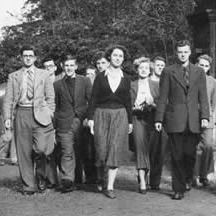
Mid-1960s. Mostly men, short hair, wearing ties, baggy trousers, middle class.
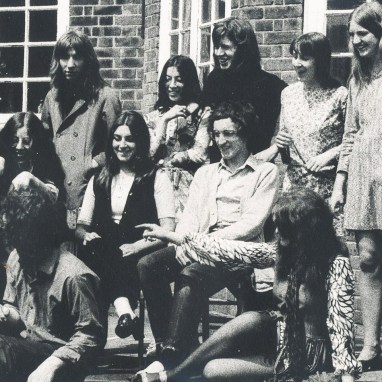
By the end of the decade, more women, long hair, no ties, still middle class but more radical politics.
Going to university as a student in the 1960s was a completely different experience compared to fifty years later. The children of working class[1] families never went to university; virtually all university students were middle class[2]. A university education was an indicator of your middle class status. I recall discussing higher education with a fellow student who was cock-a-hoop because we were now part of the ‘top two percent’[3]. I could not really relate to that, coming as I did from the bottom 2%.
The Robbins Report, produced by Parliament in 1963 described Britain’s universities as small in number and in size, élitist and predominantly male. Oxford, Cambridge and the four ancient Scottish universities were the heart of the system, acting as a finishing school for public schools and the foundation stone for the country’s political, financial and social leadership.
There were 18 other universities including the great civic institutions of the main cities: London, Durham, Newcastle, the colleges of the University of Wales, Birmingham, Manchester, Leeds, Liverpool, Sheffield, Bristol, Dundee, Exeter, Hull, Leicester, Nottingham, Reading, Queen’s Belfast and Southampton. Their role was to educate the sons, especially of the middle classes, for their destiny in the professions and industry.
There were 118,400 university students in 1963. Robbins said that undergraduate places should be available ‘to all who were qualified for them by ability and attainment’. In 1962, tuition fees were paid by the government and generous grants awarded for living expenses.
Many new universities were already being set up and in the 1960s another 13 were opened: Sussex (1961), Keele (1962), East Anglia (1963), York (1963), Lancaster (1964), Essex (1964-65), Strathclyde (1964), Kent (1965), Warwick (1965), Heriot-Watt (1966), Salford (1967), Stirling (1967) and Ulster (1968).
In 1965, plans were laid to open more Polytechnics, degree-level institutions with a technical basis. Over the next few years over 30 were opened across the UK, each awarding degrees through the Council for National Academic Awards, or CNAA.
In 1966, ten colleges of advanced technology, originally founded in 1956, became universities: Aston, Loughborough, City University London, Surrey, Brunel, Bath, Cardiff (initially part of the University of Wales), Salford and Bradford. Plus, the university I would attend in 1967, Chelsea College of Science and Technology. In 1967, full-time student numbers reached 197,000 which included myself.
Student numbers increased slowly over the next few years. From 1992 dozens of polytechnics and other higher education institutions were given university status, massively increasing the number of university students. By 1998 student numbers were over one million and tuition fees of £1000 were introduced by the Labour government. By 2012 student numbers were approaching two million and annual fees of up to £9,000 were introduced by the Conservative government.
In 2015-16, the number of students in higher education in the UK was calculated at 2.28 million. Oxford and Cambridge are still dominated by the upper middle class; Oxford has just 11.5% ‘working class’ students. Redbrick universities and 1960s new universities are claimed by the lower middle class: Birmingham University manged to accept only 23% ‘working class’ students. The ex-polytechnics are filled with working class students paying for lower quality degrees: The University of Greenwich is 55% ‘working class’.
In 1963 the Robbins Report talked about making sure that those ‘with ability’ were able to attend university; I presume that included the likes of me. Robbins showed that only 3% of the children of ‘skilled, semi-skilled and unskilled manual workers’ would go on to full-time higher education, compared with over 50% of the children of ‘professional and managerial’ or other white-collar occupations.
In 1967, just over three working class children in 100 would go to university. Nearly 97% of working class children had no opportunity to go for higher education. Boys had a better chance; only one girl in 100 would go to university. Once they got there, they would find that if they were in a university intake of 100 students, they would be lucky if two or three other students were from their social class. Universities were middle class institutions (except Oxbridge which had higher aspirations). Working class students, who did not share any of their ideals, would be lost, seen as quaint or odd, or simply ignored.
In some ways, the situation for working class students has not changed as dramatically as was hoped for in the Robbins Report. Fifty years later there might be a few more working class students at the older universities but Birmingham University only increased their working class entrants to just under a quarter. The hundreds of thousand working class students who are now able to go to university have been consigned to the old polytechnics, renamed ‘universities’ in the 1990s.
[1] There are many and different definitions of ‘working class’. The term ‘working class’ in this diary should be taken as a generalisation. Fifty years later I may not be described as ‘working class’ but in 1967 I definitely was.
[2] See footnote above, also applicable to ‘middle class’.
[3] The Robbins Report noted that 4% of those in the age range for university entrance were offered a place. In 1962 twice as many men were university entrants compared to women.
 50 years ago today
My husband John and I, Dorothy, both went to university in 1968. Our fathers had similar clerical jobs, my father having been a grammar school son of a South Wales minor, John’s having left school at 15 in Lincoln City and having fought in WW2. We both found a few friends from similar backgrounds, but, as you record above, many were from professional homes and though I had stayed in Wales, many friends were more confident and more widely travelled than I was. We met on a post graduate librarianship course where friends came from mainly ‘lower middle class’ homes. We now live in Stamford in Lincolnshire where people from our social backgrounds generally lack our educational level, and also lack the confidence we had as school leavers. Selective Education in Endowed Schools here have given those who failed 11 plus the sense of ‘also rans’, and some consequently have failed to reach their educational potential. Many now assume they will move through school, FE college to ‘Uni’ and work in bars or coffee shops to pay their way through their courses. They can’t afford to even rent a flat in this town where they grew up as it’s popularity has drawn folk up from the South who turn small houses into holiday rentals for tourism, now the main industry for the town…most manufacturing having died last century. Few folk here fall into the ‘Working Class bracket’ of old, as nearly all are white collar. So the demographic has altered in so many ways in just one market town in half a century, and a conversation this afternoon, then reading this has brought it all together.
LikeLike